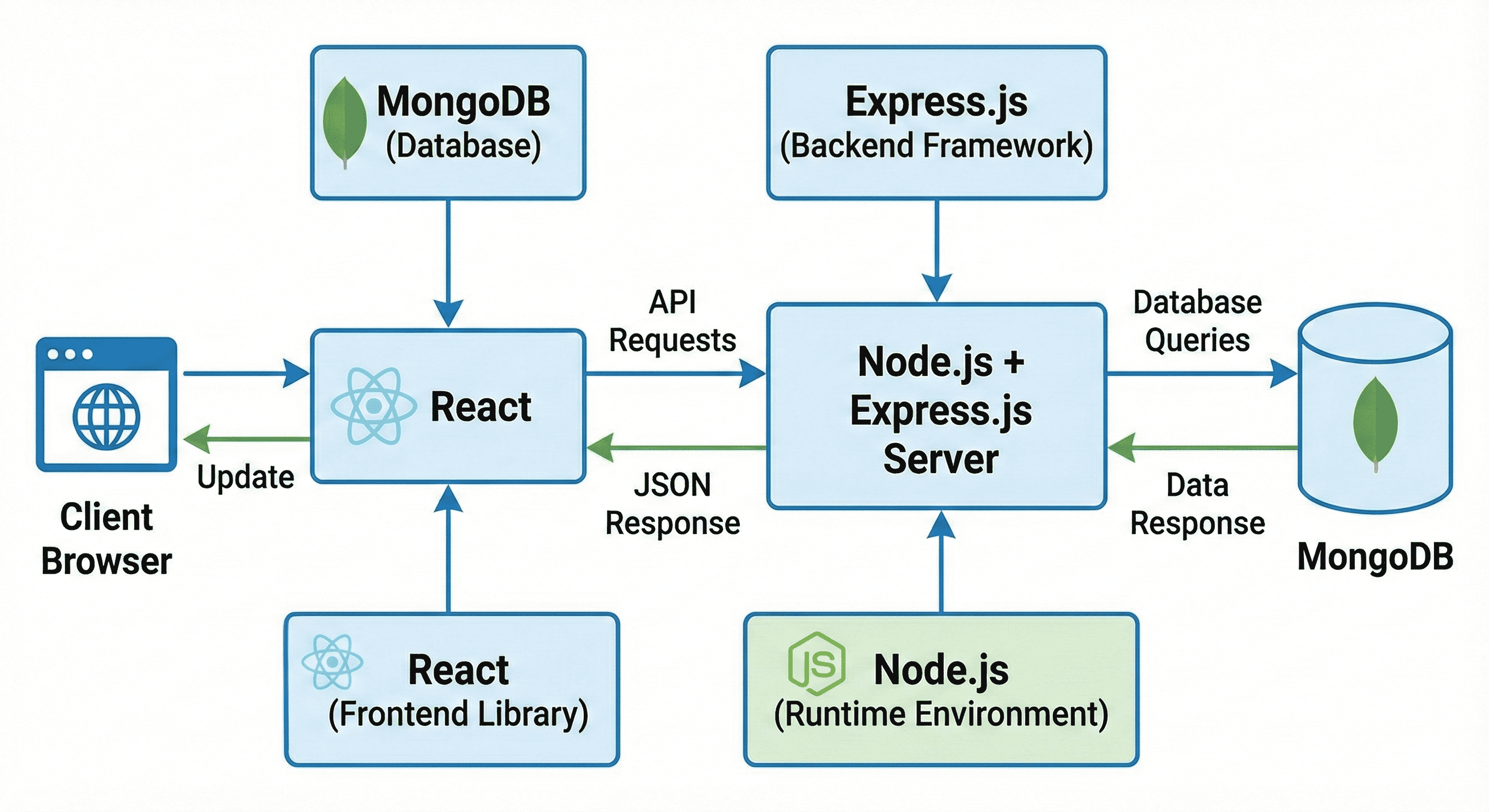
The MERN Stack is one of the most in-demand technology stacks in modern web development. It allows developers to build full-stack applications using a single programming language — JavaScript — across both frontend and backend.
Learn JavaScript Fundamentals →
If you are a student, beginner, or aspiring full-stack developer, understanding the MERN stack is not optional anymore. It is a career-defining skill set.
In this guide, you will learn:
• What MERN Stack is (clearly, not vaguely)
• How it actually works in real applications
• When you should and should NOT use MERN
• Career scope, salary insights, and a learning roadmap
• Real-world project ideas
No fluff. No copied definitions. Just what matters.
What Does MERN Stand For?
MERN stands for:
• MongoDB – Database
• Express.js – Backend framework
• React.js – Frontend library
• Node.js – Runtime environment
Together, these technologies help you build complete web applications — from database to user interface — using JavaScript everywhere.
This is why MERN is called a full-stack JavaScript framework (even though technically it’s a stack, not a framework).
How the MERN Stack Works Together
Most beginner articles fail here. Let’s fix that.
Step-by-step flow in a real MERN app:
User interacts with the UI (React)
• Clicks a button
• Submits a form
• Requests data
React sends a request to the backend
• Uses Fetch or Axios
• Calls a REST API endpoint
Express + Node handle the request
• Validate data
• Apply business logic
• Decide what database action is needed
MongoDB stores or retrieves data
• Data is stored as JSON-like documents
• Fast and scalable
Response goes back to React
• JSON data is returned
• UI updates instantly
This clean, predictable flow is why MERN is loved for single-page applications (SPAs).
Why Developers Choose MERN Stack
MERN is not popular by accident.
Key advantages:
-
One Language Everywhere :- JavaScript on frontend, backend, and database logic → faster learning and development.
-
High Performance :- Node.js uses non-blocking I/O → excellent for real-time apps.
-
Component-Based UI :- React encourages reusable components → cleaner and maintainable code.
-
Massive Community Support :- Problems are already solved. Documentation, tutorials, and libraries are everywhere.
-
Perfect for Startups :- Fast development + scalability = ideal for MVPs and growing products.
When You Should NOT Use MERN Stack
Avoid MERN if:
• Your application is CPU-intensive (e.g., heavy data science)
• You need strict relational data with complex joins
• Your team already specializes in Java / .NET / Python ecosystems
• SEO is critical and the app is poorly optimized for SSR
Knowing when not to use a technology is a sign of maturity.
MERN Stack vs MEAN vs LAMP
How does MERN compare to other popular stacks?
MERN Stack: JavaScript (Node.js) with React frontend and MongoDB. Modern and flexible, best for dynamic applications.
MEAN Stack: JavaScript (Node.js) with Angular frontend and MongoDB. More structured but steeper learning curve.
LAMP Stack: PHP-based with MySQL database. Traditional approach, easier to learn but less suited for modern real-time apps.
Verdict
MERN is preferred over MEAN today because React is generally faster and more popular than Angular. It supersedes LAMP for modern apps requiring real-time updates (like Single Page Applications).
Career Scope of MERN Stack(2026)
If you’re learning MERN for career reasons, here’s the truth:
Job roles:
• Full-Stack Developer
• Frontend Developer (React)
• Backend Developer (Node.js)
• Software Engineer
Salary insight (approximate):
• Freshers: Competitive entry-level salaries
• Mid-level: Strong growth with experience
• Freelancers: High demand globally
MERN is not a “trend skill.” It is a long-term employable stack.
MERN Stack Learning Roadmap (Beginner → Job-Ready)
Follow this order or you’ll struggle:
1.HTML, CSS (Flexbox, Grid)
2.JavaScript fundamentals (ES6+)
3.Git & GitHub
4.React basics → hooks → state management
5.Node.js fundamentals
6.Express.js & REST APIs
7.MongoDB & Mongoose
8.Authentication (JWT)
9.Deployment (basic)
Skipping steps = confusion later.
Best MERN Stack Project Ideas for Beginners
Projects are what separate learners from developers.
Start with:
• To-Do App (CRUD + state management)
• Authentication System (login/signup)
• Blog Platform (roles, database relations)
Advance to:
• Real-time chat app
• E-commerce store
• Dashboard with analytics
If you can explain your project clearly, you’re employable. date: "2025-01-19".
Common Beginner Mistakes with MERN Stack
Learn from others’ failures:
• Learning React before JavaScript fundamentals
• Ignoring backend concepts
• Copy-pasting tutorials without understanding
• Avoiding deployment
• Building projects without structure
Fix these early.
Final Verdict: Is MERN Stack Worth Learning?
Yes — if you are serious.
MERN is beginner-friendly, powerful, and widely adopted. But it rewards discipline, projects, and consistency, not shortcuts.
If your goal is to become a full-stack developer, MERN is one of the smartest paths you can take today.